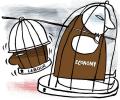
Ushering in a big wave of reforms by implementing the four labour codes, setting up the national social security fund to cover over 38 crore informal sector workers and improving the ease of doing business will top the agenda of the labour ministry in the New Year. In a major move, the ministry launched the e-Shram portal on August 26, 2021 for creating a national database of over 38 crore informal sector workers. It will help the government to ensure last-mile delivery of benefits of various social security schemes to the informal-sector workers.

After witnessing cloudy skies this year, the country's renewable energy sector is expected to boom with a likely investment of over $15 billion in 2022 as the government focuses on electric vehicles, green hydrogen, manufacturing of solar equipment as well as achieving the ambitious 175 GW renewable capacity target. India, which has an installed renewable energy generation capacity of a little over 150 GW, aims to reach 175 GW in 2022. Out of the total mix, 100 GW would be from solar, 60 GW from wind, 10 GW from bio-power and 5 GW from small hydro power projects.

A greater payment security mechanism for power generation companies to ensure timely payouts for supply of electricity will be in focus in 2022 as stricter rules are on the anvil for 24x7 power supply amid discoms' outstanding dues at a whopping Rs 1.56 lakh crore. Mounting outstanding dues of distribution companies (discoms) to electricity generation companies (gencos) have been a perennial issue affecting the entire value chain in the power sector and are also a hindrance for the ambitious goal of 24x7 power supply across the country even when the payment for coal is made in advance. The situation persists despite the fact that discoms' dues become overdue after 45 days of generating bills and they also have to pay penal interest on the overdue amount in most of the cases to gencos.
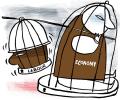
The implementation of four labour codes in one go from April 1 next year will usher in a new wave of reforms in industrial relations and also help in attracting more investments but employment generation will remain a key challenge in 2021. This year has also been a challenging year for the work force as well as for employers due to the outbreak of the COVID-19 pandemic. The government imposed a nationwide lockdown from March 25, which had an adverse impact on economic activities and resulted in exodus of migrant workers from large cities to their homes in the hinterland. Many migrant labourers lost their jobs and it took months for them to return back to their work places from their native places.

According to the EPFO estimates, there would be a surplus of Rs 151.67 crore after providing 8.65 per cent rate of interest for 2018-19 on EPF.

The fate of the ministerial conference was sealed after assistant US trade representative Sharon Bomer Lauritsen said permanent solution to the food stockholding issue was not acceptable to America.

India too will advocate the IMF quote reforms at the two-day meeting of G20 Finance Ministers and Central Bank Governors beginning Saturday.

The Central revenue department is inquiring into the payment of service tax by the event management firm which had organised the controversial Thinkfest on behalf of the Tehelka magazine.
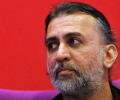
The Central revenue department is inquiring into the payment of service tax by the event management firm which had organised the controversial Thinkfest on behalf of the Tehelka magazine.
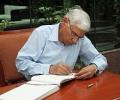

After taking charge, P Chidambaram promised fine-tuning of policies and place a stable tax regime.

The wholesale price-based inflation hovered over seven per cent through 2012, down from 10 per cent inflation seen in the previous year, reflecting the impact of tight money policy of the Reserve Bank of India.

The proposed comprehensive free trade agreement between India and the 27-nation EU bloc includes relaxation of visa norms for professionals.

The minister, who was in Brussels on a two-day visit, said that seven Chief Minsters including Maharashtra, Haryana, Andhra Pradesh, Delhi, Assam, Rajasthan and Kerala have already given their written commitment on allowing FDI in the sector.

Warning that volatility in international food and fuel prices may be on the way to becoming a long term and global phenomenon, India on Thursday called for a coordinated effort at the global level to control inflation.
The assurance was given by Vietnamese Prime Minister Nguyen Tan Dung when India's Finance Minister Pranab Mukherjee called on him in Hanoi.
Talking to reporters on the sidelines of the G-20 Finance Ministers' meeting in Paris, Mukherjee said fiscal expansionary policies were required in the past, in the wake of global financial crisis.

Often criticised for offering less attractive interest rates than banks for most of the last five years, retirement fund manager EPFO hiked the annual rate of returns on employee provident funds to 9.5 per cent in 2010 and this time around, the banks were left behind.

India achieved the distinction of being the second fastest growing economy amid the global recession in 2009, but the joy was marred by the decade's sharpest rise in food prices to the chagrin of common man.
Besides undertaking the routine work, Ahluwalia entrusted the task of revamping the Commission to new member Arun Maira, formerly with the Boston Consultancy Group. "We cannot work is silos. We need better lateral inputs," Ahluwalia had said at a recent internal meeting of the commission.
 © 2026 Rediff.com - Advertise with us - Disclaimer - Privacy Policy - Sitemap - Feedback - About us - Terms of use - Grievances